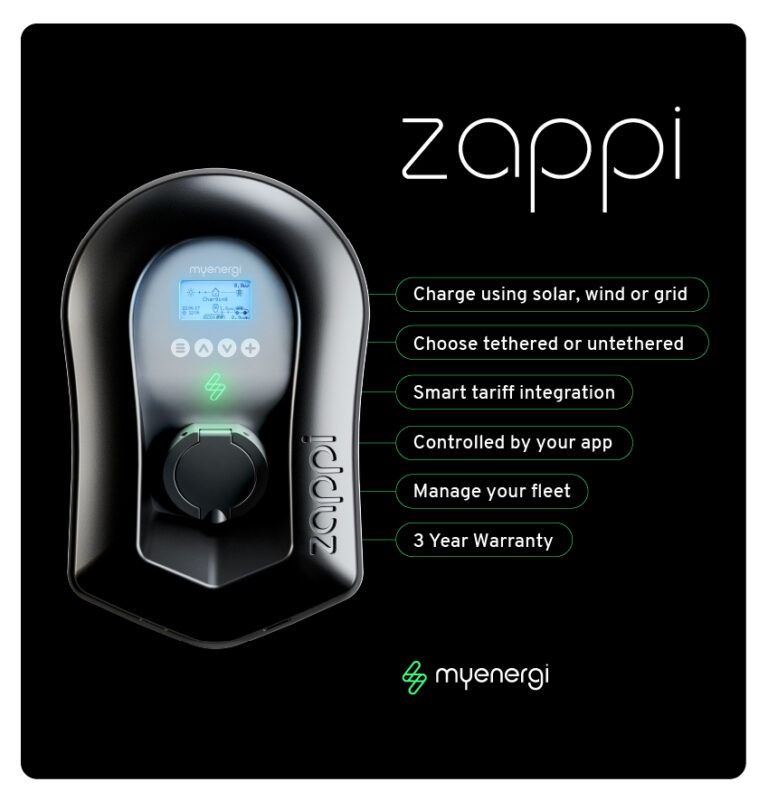
myenergi Zappi v2
~£1,100–£1,500 inc. installation
- 7kW single-phase / 22kW three-phase
- Three charging modes: Fast, Eco, Eco+
- True solar energy diversion (Eco+ = 100% solar)
- Built-in PEN fault detection (no earth rod needed)
- Smart tariff support (Octopus Intelligent Go, Gridpay)
- UK-designed and manufactured in Lincolnshire
- 6.5m tethered cable
- IP65 rated
- 3-year warranty
- OZEV grant eligible
 ## Quick Verdict
**The myenergi Zappi v2 is the best home EV charger for solar panel owners — full stop.** Its three charging modes (including 100% solar-only Eco+) are unmatched by any competitor. The built-in PEN detection saves on installation costs, and it integrates with Octopus Intelligent Go for overnight grid charging too. The downsides are price and a 3-year warranty that's shorter than some rivals.
**Pros:**
- Unmatched solar integration with three distinct modes
- Eco+ mode charges exclusively from surplus solar — genuinely free driving
- Built-in PEN fault detection saves £100–£150 on installation
- Smart tariff support (Octopus Intelligent Go, Gridpay)
- UK-designed and manufactured (Stallingborough, Lincolnshire)
- Part of the myenergi ecosystem (Eddi, Libbi, Harvi)
- IP65 rated — excellent weather resistance
- Available in tethered and untethered variants
- Both black and white colour options
**Cons:**
- Most expensive mainstream home charger (~£1,100–£1,500 installed)
- 3-year warranty (some competitors offer 5 years)
- Eco+ mode is weather-dependent — slow on cloudy days
- App is functional rather than polished
- Solar features wasted if you don't have panels
- Trustpilot reviews flag occasional app reliability issues
---
## The Three Charging Modes — The Zappi's Killer Feature
The Zappi's entire value proposition centres on its three charging modes. No other home charger offers this level of control over your energy source.
### Fast Mode
Fast mode draws maximum power from the grid at 7kW (single-phase) or 22kW (three-phase). This is identical to how any standard home EV charger works. Use it when you need a quick charge and don't care about the electricity source — overnight on a cheap tariff, for instance.
### Eco Mode
Eco mode is the everyday sweet spot for most solar owners. It prioritises solar energy but tops up from the grid to maintain a minimum charge rate. If your panels are generating 3kW and the charger needs 7kW, it pulls 3kW from solar and 4kW from the grid. You get the benefit of free solar energy without the uncertainty of weather-dependent charging.
### Eco+ Mode
This is the headline feature. Eco+ charges your car exclusively from surplus solar energy — zero grid draw. When clouds roll over and solar generation drops below the minimum threshold, charging pauses. When the sun returns, it resumes. Your cost per mile drops to effectively zero.
The trade-off is obvious: Eco+ is weather-dependent and slow. On a bright summer day in southern England, a 4kW solar array might generate enough surplus to add 60–80 miles of range. On a grey November morning in Scotland, you might get almost nothing. For daily commuters relying on consistent range, Eco+ should complement grid charging rather than replace it entirely.
**Real-world savings example:** A typical 4kW solar array in the Midlands generates roughly 3,400kWh annually. If you divert 30% of that to your EV via Eco+ mode, you get approximately 1,020kWh of free charging — enough for around 4,000 miles. At current grid electricity rates (~24p/kWh), that's roughly £245 saved per year, just from solar.
## Solar Integration — How It Works
The Zappi connects to your solar system via a CT (current transformer) clamp that's included in the box. This clamp monitors your home's solar generation and household consumption in real time, calculating genuine surplus energy and diverting it to your car.
If you can't easily run the CT clamp cable, myenergi sells the Harvi — a wireless energy sensor — separately. It does the same job without the wiring.
What makes the Zappi's solar integration superior to competitors is that it's **hardware-based**, not a software bolt-on. The [Ohme Home Pro](/reviews/ohme-home-pro-review/) supports basic solar charging via a CT clamp, but it can't match the Zappi's dedicated Eco+ (100% solar-only) mode. The Ohme's solar feature is more of a "nice to have"; the Zappi's is the core product.
### The myenergi Ecosystem
The Zappi is part of a broader energy management ecosystem:
- **Eddi** — diverts surplus solar to your immersion heater or other heating
- **Libbi** — modular home battery storage
- **Harvi** — wireless energy sensing
Together, these devices create a complete self-consumption system. The myenergi app manages all of them from one interface. If you're serious about maximising your solar investment, the ecosystem approach is compelling — heat your water with Eddi during the day, charge your car with Zappi, and store excess in Libbi for evening use.
## Smart Tariff Support
The Zappi isn't just for solar owners. It also supports smart electricity tariffs:
- **Octopus Intelligent Go** — the Zappi communicates with Octopus to charge during the cheapest overnight slots
- **Gridpay** — myenergi's own smart tariff integration platform
- **Manual scheduling** — set specific charging windows via the app
The Octopus integration works well, though it's not quite as seamless as the [Ohme Home Pro's](/reviews/ohme-home-pro-review/) deep Intelligent Octopus integration. With the Ohme, you set a departure time and charge level and it handles everything. With the Zappi, the integration is functional but requires a bit more manual setup.
For most people, combining Eco mode during the day (solar priority) with cheap-rate grid charging overnight gives the lowest possible cost per mile — potentially as low as 1–3p per mile.
## The myenergi App
The myenergi app (iOS and Android) handles scheduling, mode switching, real-time energy monitoring, and historical data. It shows you exactly where your energy is coming from (solar, grid, or both) and how much each charge session is costing.
It's functional and informative, but — honestly — it's not the most polished app in the category. The Ohme and Wallbox apps both feel more modern and intuitive. The myenergi app occasionally suffers from slow loading, and some users report connectivity issues that require re-pairing.
That said, it's improved significantly with recent updates, and it does everything you actually need. It just won't win any design awards.
## Design and Build Quality
The Zappi v2 is a solid, well-built unit. It's larger than the ultra-compact Wallbox Pulsar Plus, but it's far from bulky. Available in black or white, it looks clean and understated on a wall.
IP65 rated — the highest weather resistance in our roundup — it handles everything the British climate throws at it. The tethered variant comes with a 6.5m cable, which is reasonable though slightly shorter than the Ohme's 7.5m. An untethered option is available if you prefer to use your own cable.
The built-in PEN fault detection is a practical bonus. Like the Wallbox Pulsar Plus, this eliminates the need for a separate earth rod, saving £100–£150 on installation and keeping things tidier.
**Made in the UK:** The Zappi is designed and manufactured at myenergi's facility in Stallingborough, Lincolnshire. Over 500,000 devices have been shipped. If buying British matters to you, the Zappi is one of the few genuinely UK-made options alongside the Andersen A2.
## Installation
Installation is straightforward and typically takes 2–3 hours. The built-in PEN detection is a genuine time and cost saver. You'll need a qualified, registered electrician — and for the OZEV grant, an OZEV-approved installer.
The installed cost (unit plus installation) typically runs £1,100–£1,500 for a single-phase tethered model, depending on cable run length and any consumer unit work required. That's £300–£500 more than an Ohme Home Pro and significantly more than a Pod Point Solo 3.
If you're eligible for the OZEV grant (renters, flat owners, landlords), you can deduct £350. See our [OZEV grant guide](/guides/ev-charger-government-grant-uk/) for full details.
## Value for Money
Let's not dance around it: the Zappi is expensive. At £1,100–£1,500 installed, it's the priciest mainstream charger we've reviewed. The premium over an Ohme Home Pro is £300–£500, and over a Pod Point Solo 3 it's £400–£800.
Is it worth it? That depends entirely on whether you have solar panels.
**With solar panels:** The Zappi's Eco+ mode can deliver £200–£300 of free charging per year. At that rate, the premium pays for itself within 1–2 years, and every year after that is pure savings. If you're also pairing it with Eddi and Libbi, the whole-home energy savings are substantial.
**Without solar panels:** The Zappi works as a competent grid charger with Octopus Intelligent Go support, but you're paying a significant premium for solar features you'll never use. In that case, the [Ohme Home Pro](/reviews/ohme-home-pro-review/) at ~£799 or the [Pod Point Solo 3](/reviews/pod-point-solo-3-review/) at ~£699 are much better value.
## Who Should Buy the myenergi Zappi v2?
**Buy the Zappi if:**
- You have solar panels and want to charge your EV with free solar energy
- You're planning to install solar panels in the near future
- You want to build a complete myenergi ecosystem (Eddi, Libbi, Harvi)
- You value UK-designed and manufactured products
- You want the best weather resistance (IP65)
- You need a three-phase option (22kW)
**Look elsewhere if:**
- You don't have solar panels and don't plan to get them (→ [Ohme Home Pro](/reviews/ohme-home-pro-review/))
- Price is your primary concern (→ [Pod Point Solo 3](/reviews/pod-point-solo-3-review/))
- You want the most polished app experience (→ Ohme Home Pro)
- You want a more compact charger (→ [Wallbox Pulsar Plus](/reviews/wallbox-pulsar-plus-review/))
## Our Verdict
**Rating: ★★★★★ 4.7/5**
The myenergi Zappi v2 is the best home EV charger for anyone with solar panels — and it's not close. The Eco+ mode delivers genuinely free driving, the build quality is excellent, and the broader myenergi ecosystem turns your home into a proper energy management system.
The price premium is real, but for solar owners, the payback period is typically 1–2 years. After that, you're charging your car on sunshine for free.
If you don't have solar, buy an Ohme Home Pro and save yourself £300+. If you do have solar, the Zappi is the obvious choice and one of the smartest home investments you can make.
Check Current Price on Amazon →
---
## Frequently Asked Questions
### Can I use the myenergi Zappi without solar panels?
Yes. The Zappi works perfectly well as a standard grid charger. It supports Octopus Intelligent Go and manual scheduling for off-peak charging. However, the solar features are its main selling point, and without panels, you're paying a premium for capabilities you won't use. Consider the [Ohme Home Pro](/reviews/ohme-home-pro-review/) instead.
### How much money can the Zappi save with solar panels?
A typical 4kW solar array in the UK Midlands can provide roughly £200–£300 of free EV charging per year via Eco+ mode. In southern England with higher solar generation, savings can be even greater. Combined with cheap-rate overnight grid charging, total annual savings can exceed £500.
### Does the Zappi work with Octopus Energy?
Yes. The Zappi supports Octopus Intelligent Go for automated overnight charging at cheap rates. It also works with myenergi's own Gridpay platform. The integration is functional, though not quite as seamless as the Ohme Home Pro's Intelligent Octopus integration.
### Is the myenergi Zappi OZEV grant eligible?
Yes. The Zappi is eligible for the OZEV grant (up to £350 off installation costs), available to renters, flat owners, and landlords. Homeowners who own their property are not currently eligible.
### What's the difference between the Zappi v2 and the new Zappi GLO?
The Zappi GLO is myenergi's newer model with updated aesthetics, improved LED indicators, and enhanced connectivity. The core charging functionality and solar integration modes remain the same. The Zappi v2 remains widely available and fully supported, often at a lower price point.
### How does the Zappi compare to the Ohme Home Pro for solar?
The Zappi is significantly better for solar integration. Its Eco+ mode charges exclusively from solar surplus — something the Ohme can't match. The Ohme supports basic solar via a CT clamp and can prioritise solar, but it doesn't offer a true "100% solar only" mode. If solar is your priority, the Zappi wins decisively.
---
*See also: [Ohme Home Pro Review](/reviews/ohme-home-pro-review/) · [Pod Point Solo 3 Review](/reviews/pod-point-solo-3-review/) · [Ohme vs Pod Point Comparison](/reviews/ohme-vs-pod-point/) · [Best Home EV Chargers UK 2026](/best-picks/best-home-ev-chargers-uk/)*
## Quick Verdict
**The myenergi Zappi v2 is the best home EV charger for solar panel owners — full stop.** Its three charging modes (including 100% solar-only Eco+) are unmatched by any competitor. The built-in PEN detection saves on installation costs, and it integrates with Octopus Intelligent Go for overnight grid charging too. The downsides are price and a 3-year warranty that's shorter than some rivals.
**Pros:**
- Unmatched solar integration with three distinct modes
- Eco+ mode charges exclusively from surplus solar — genuinely free driving
- Built-in PEN fault detection saves £100–£150 on installation
- Smart tariff support (Octopus Intelligent Go, Gridpay)
- UK-designed and manufactured (Stallingborough, Lincolnshire)
- Part of the myenergi ecosystem (Eddi, Libbi, Harvi)
- IP65 rated — excellent weather resistance
- Available in tethered and untethered variants
- Both black and white colour options
**Cons:**
- Most expensive mainstream home charger (~£1,100–£1,500 installed)
- 3-year warranty (some competitors offer 5 years)
- Eco+ mode is weather-dependent — slow on cloudy days
- App is functional rather than polished
- Solar features wasted if you don't have panels
- Trustpilot reviews flag occasional app reliability issues
---
## The Three Charging Modes — The Zappi's Killer Feature
The Zappi's entire value proposition centres on its three charging modes. No other home charger offers this level of control over your energy source.
### Fast Mode
Fast mode draws maximum power from the grid at 7kW (single-phase) or 22kW (three-phase). This is identical to how any standard home EV charger works. Use it when you need a quick charge and don't care about the electricity source — overnight on a cheap tariff, for instance.
### Eco Mode
Eco mode is the everyday sweet spot for most solar owners. It prioritises solar energy but tops up from the grid to maintain a minimum charge rate. If your panels are generating 3kW and the charger needs 7kW, it pulls 3kW from solar and 4kW from the grid. You get the benefit of free solar energy without the uncertainty of weather-dependent charging.
### Eco+ Mode
This is the headline feature. Eco+ charges your car exclusively from surplus solar energy — zero grid draw. When clouds roll over and solar generation drops below the minimum threshold, charging pauses. When the sun returns, it resumes. Your cost per mile drops to effectively zero.
The trade-off is obvious: Eco+ is weather-dependent and slow. On a bright summer day in southern England, a 4kW solar array might generate enough surplus to add 60–80 miles of range. On a grey November morning in Scotland, you might get almost nothing. For daily commuters relying on consistent range, Eco+ should complement grid charging rather than replace it entirely.
**Real-world savings example:** A typical 4kW solar array in the Midlands generates roughly 3,400kWh annually. If you divert 30% of that to your EV via Eco+ mode, you get approximately 1,020kWh of free charging — enough for around 4,000 miles. At current grid electricity rates (~24p/kWh), that's roughly £245 saved per year, just from solar.
## Solar Integration — How It Works
The Zappi connects to your solar system via a CT (current transformer) clamp that's included in the box. This clamp monitors your home's solar generation and household consumption in real time, calculating genuine surplus energy and diverting it to your car.
If you can't easily run the CT clamp cable, myenergi sells the Harvi — a wireless energy sensor — separately. It does the same job without the wiring.
What makes the Zappi's solar integration superior to competitors is that it's **hardware-based**, not a software bolt-on. The [Ohme Home Pro](/reviews/ohme-home-pro-review/) supports basic solar charging via a CT clamp, but it can't match the Zappi's dedicated Eco+ (100% solar-only) mode. The Ohme's solar feature is more of a "nice to have"; the Zappi's is the core product.
### The myenergi Ecosystem
The Zappi is part of a broader energy management ecosystem:
- **Eddi** — diverts surplus solar to your immersion heater or other heating
- **Libbi** — modular home battery storage
- **Harvi** — wireless energy sensing
Together, these devices create a complete self-consumption system. The myenergi app manages all of them from one interface. If you're serious about maximising your solar investment, the ecosystem approach is compelling — heat your water with Eddi during the day, charge your car with Zappi, and store excess in Libbi for evening use.
## Smart Tariff Support
The Zappi isn't just for solar owners. It also supports smart electricity tariffs:
- **Octopus Intelligent Go** — the Zappi communicates with Octopus to charge during the cheapest overnight slots
- **Gridpay** — myenergi's own smart tariff integration platform
- **Manual scheduling** — set specific charging windows via the app
The Octopus integration works well, though it's not quite as seamless as the [Ohme Home Pro's](/reviews/ohme-home-pro-review/) deep Intelligent Octopus integration. With the Ohme, you set a departure time and charge level and it handles everything. With the Zappi, the integration is functional but requires a bit more manual setup.
For most people, combining Eco mode during the day (solar priority) with cheap-rate grid charging overnight gives the lowest possible cost per mile — potentially as low as 1–3p per mile.
## The myenergi App
The myenergi app (iOS and Android) handles scheduling, mode switching, real-time energy monitoring, and historical data. It shows you exactly where your energy is coming from (solar, grid, or both) and how much each charge session is costing.
It's functional and informative, but — honestly — it's not the most polished app in the category. The Ohme and Wallbox apps both feel more modern and intuitive. The myenergi app occasionally suffers from slow loading, and some users report connectivity issues that require re-pairing.
That said, it's improved significantly with recent updates, and it does everything you actually need. It just won't win any design awards.
## Design and Build Quality
The Zappi v2 is a solid, well-built unit. It's larger than the ultra-compact Wallbox Pulsar Plus, but it's far from bulky. Available in black or white, it looks clean and understated on a wall.
IP65 rated — the highest weather resistance in our roundup — it handles everything the British climate throws at it. The tethered variant comes with a 6.5m cable, which is reasonable though slightly shorter than the Ohme's 7.5m. An untethered option is available if you prefer to use your own cable.
The built-in PEN fault detection is a practical bonus. Like the Wallbox Pulsar Plus, this eliminates the need for a separate earth rod, saving £100–£150 on installation and keeping things tidier.
**Made in the UK:** The Zappi is designed and manufactured at myenergi's facility in Stallingborough, Lincolnshire. Over 500,000 devices have been shipped. If buying British matters to you, the Zappi is one of the few genuinely UK-made options alongside the Andersen A2.
## Installation
Installation is straightforward and typically takes 2–3 hours. The built-in PEN detection is a genuine time and cost saver. You'll need a qualified, registered electrician — and for the OZEV grant, an OZEV-approved installer.
The installed cost (unit plus installation) typically runs £1,100–£1,500 for a single-phase tethered model, depending on cable run length and any consumer unit work required. That's £300–£500 more than an Ohme Home Pro and significantly more than a Pod Point Solo 3.
If you're eligible for the OZEV grant (renters, flat owners, landlords), you can deduct £350. See our [OZEV grant guide](/guides/ev-charger-government-grant-uk/) for full details.
## Value for Money
Let's not dance around it: the Zappi is expensive. At £1,100–£1,500 installed, it's the priciest mainstream charger we've reviewed. The premium over an Ohme Home Pro is £300–£500, and over a Pod Point Solo 3 it's £400–£800.
Is it worth it? That depends entirely on whether you have solar panels.
**With solar panels:** The Zappi's Eco+ mode can deliver £200–£300 of free charging per year. At that rate, the premium pays for itself within 1–2 years, and every year after that is pure savings. If you're also pairing it with Eddi and Libbi, the whole-home energy savings are substantial.
**Without solar panels:** The Zappi works as a competent grid charger with Octopus Intelligent Go support, but you're paying a significant premium for solar features you'll never use. In that case, the [Ohme Home Pro](/reviews/ohme-home-pro-review/) at ~£799 or the [Pod Point Solo 3](/reviews/pod-point-solo-3-review/) at ~£699 are much better value.
## Who Should Buy the myenergi Zappi v2?
**Buy the Zappi if:**
- You have solar panels and want to charge your EV with free solar energy
- You're planning to install solar panels in the near future
- You want to build a complete myenergi ecosystem (Eddi, Libbi, Harvi)
- You value UK-designed and manufactured products
- You want the best weather resistance (IP65)
- You need a three-phase option (22kW)
**Look elsewhere if:**
- You don't have solar panels and don't plan to get them (→ [Ohme Home Pro](/reviews/ohme-home-pro-review/))
- Price is your primary concern (→ [Pod Point Solo 3](/reviews/pod-point-solo-3-review/))
- You want the most polished app experience (→ Ohme Home Pro)
- You want a more compact charger (→ [Wallbox Pulsar Plus](/reviews/wallbox-pulsar-plus-review/))
## Our Verdict
**Rating: ★★★★★ 4.7/5**
The myenergi Zappi v2 is the best home EV charger for anyone with solar panels — and it's not close. The Eco+ mode delivers genuinely free driving, the build quality is excellent, and the broader myenergi ecosystem turns your home into a proper energy management system.
The price premium is real, but for solar owners, the payback period is typically 1–2 years. After that, you're charging your car on sunshine for free.
If you don't have solar, buy an Ohme Home Pro and save yourself £300+. If you do have solar, the Zappi is the obvious choice and one of the smartest home investments you can make.
Check Current Price on Amazon →
---
## Frequently Asked Questions
### Can I use the myenergi Zappi without solar panels?
Yes. The Zappi works perfectly well as a standard grid charger. It supports Octopus Intelligent Go and manual scheduling for off-peak charging. However, the solar features are its main selling point, and without panels, you're paying a premium for capabilities you won't use. Consider the [Ohme Home Pro](/reviews/ohme-home-pro-review/) instead.
### How much money can the Zappi save with solar panels?
A typical 4kW solar array in the UK Midlands can provide roughly £200–£300 of free EV charging per year via Eco+ mode. In southern England with higher solar generation, savings can be even greater. Combined with cheap-rate overnight grid charging, total annual savings can exceed £500.
### Does the Zappi work with Octopus Energy?
Yes. The Zappi supports Octopus Intelligent Go for automated overnight charging at cheap rates. It also works with myenergi's own Gridpay platform. The integration is functional, though not quite as seamless as the Ohme Home Pro's Intelligent Octopus integration.
### Is the myenergi Zappi OZEV grant eligible?
Yes. The Zappi is eligible for the OZEV grant (up to £350 off installation costs), available to renters, flat owners, and landlords. Homeowners who own their property are not currently eligible.
### What's the difference between the Zappi v2 and the new Zappi GLO?
The Zappi GLO is myenergi's newer model with updated aesthetics, improved LED indicators, and enhanced connectivity. The core charging functionality and solar integration modes remain the same. The Zappi v2 remains widely available and fully supported, often at a lower price point.
### How does the Zappi compare to the Ohme Home Pro for solar?
The Zappi is significantly better for solar integration. Its Eco+ mode charges exclusively from solar surplus — something the Ohme can't match. The Ohme supports basic solar via a CT clamp and can prioritise solar, but it doesn't offer a true "100% solar only" mode. If solar is your priority, the Zappi wins decisively.
---
*See also: [Ohme Home Pro Review](/reviews/ohme-home-pro-review/) · [Pod Point Solo 3 Review](/reviews/pod-point-solo-3-review/) · [Ohme vs Pod Point Comparison](/reviews/ohme-vs-pod-point/) · [Best Home EV Chargers UK 2026](/best-picks/best-home-ev-chargers-uk/)*