Easee One
~£919 inc. installation
- 7.4kW charging speed (single-phase)
- Tethered and untethered from one unit
- Up to 3 chargers on one fuse (load balancing)
- Lifetime 4G eSIM + Wi-Fi backup
- RFID access control built in
- Swappable colour faceplates
- OZEV grant eligible
- 3-year warranty
 ## Quick Verdict
**The Easee One is a beautifully designed, solidly built charger that excels at hardware but falls short on smart tariff integration.** If you want a gorgeous charger with multi-unit load balancing and tethered/untethered flexibility, it's hard to beat. But if smart tariff optimisation is your priority, the Ohme Home Pro remains the better choice.
**Pros:**
- Stunning Scandinavian design with swappable faceplates
- Works tethered or untethered — your choice, changeable any time
- Up to 3 units on one fuse with automatic load balancing
- Lifetime 4G connectivity (no subscription) plus Wi-Fi backup
- Built-in RFID for access control
- Excellent build quality, IP54 + IK10 impact resistance
- No earth rod required (integrated PEN protection)
**Cons:**
- No smart tariff integration (no Intelligent Octopus, no Agile support)
- Solar charging requires the separate Easee Equalizer accessory (~£224 extra)
- App only accepts a single electricity rate (inaccurate for time-of-use tariffs)
- Pricier than rivals once installation is included
---
## Design and Build — Where the Easee One Truly Shines
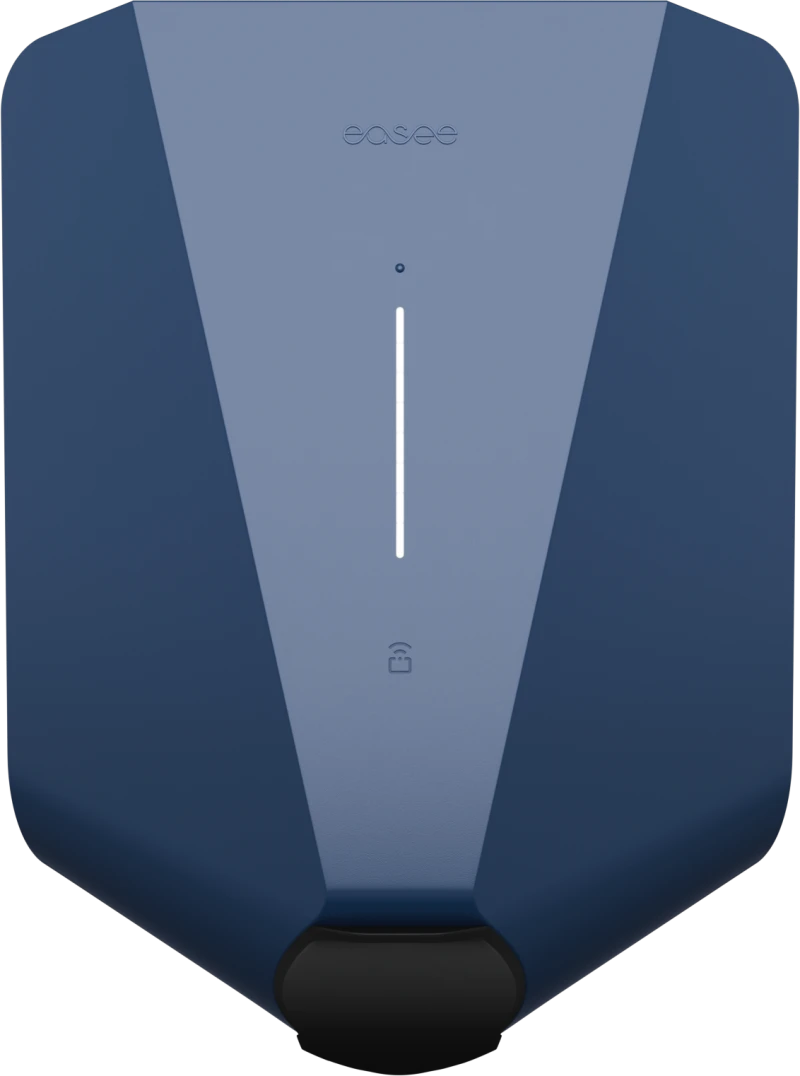
Let's get this out of the way: the Easee One is gorgeous. It's the charger equivalent of a Bang & Olufsen speaker — clean lines, matte finish, and that distinctive angled silhouette that screams Scandinavian minimalism without trying too hard.
At just 256 × 193 × 106mm and weighing only 1.5kg, it's remarkably compact. It sits on the wall without dominating it. The standard colour is black, but Easee sell swappable faceplates in a range of colours, so you can match it to your home's exterior. It's a small touch, but it matters if you care about aesthetics — and plenty of people do.
Build quality is genuinely impressive. IP54 rated for weather protection and IK10 for impact resistance, meaning it'll shrug off both Scottish rain and the occasional bump from a car door. There's no wobble when plugging and unplugging the cable, which speaks to solid mounting design.
The front features an LED light strip that shows charging status through different colours and patterns. It looks sleek, though there's a learning curve to understanding what each light pattern means. A small status screen (like the [Ohme Home Pro's](/reviews/ohme-home-pro-review/) display) would make life easier, but it's a minor gripe.
## Tethered or Untethered — You Decide
This is the Easee One's cleverest trick. Most EV chargers force you to choose at the point of purchase: do you want a permanently attached cable (tethered) or a socket you bring your own cable to (untethered)?
The Easee One says "why not both?" A lockable Type 2 port lets you lock a cable in place for tethered convenience, or remove it for a tidier look when you're not charging. You can switch between the two from the app, any time you like, with no hardware changes.
For anyone who hasn't yet decided which they prefer — or for households where preferences change — this flexibility is genuinely useful.
## Multi-Charger Load Balancing — Perfect for Flats and Multi-EV Homes
Here's where the Easee One really differentiates itself from the competition. Up to three Easee One units can run from a single 32A electrical supply using built-in wireless load balancing (Easee Link). The chargers communicate with each other and automatically share available power without overloading the circuit.
In practice, two chargers on a 32A supply each draw up to 16A (3.7kW). That's more than enough for overnight charging — most EVs will still be full by morning.
The real benefit? You avoid the significant cost of running separate electrical circuits for each charger, or upgrading your consumer unit. For blocks of flats, shared driveways, or multi-EV households, this is a standout feature. No other mainstream charger handles multi-unit installations as elegantly.
Add the optional Easee Equalizer (£224), and you get dynamic load balancing across your entire property — the charger monitors total household consumption and throttles charging to prevent tripping the main fuse.
## The Easee Charge App — Good, But Not Great
The Easee Charge app is well-designed and pleasant to use. It has that same clean Scandinavian aesthetic as the hardware — modern, intuitive, and a step above the more rudimentary apps from some competitors.
From the home screen you can see:
- Current charge status and power draw
- LED brightness controls
- Cable lock toggle (tethered/untethered switching)
- Charging schedule setup
- Session data: kWh, duration, estimated cost
- Lifetime charging totals and monthly breakdowns
There's even some fun customisation — you can change the colour of the animated charging wave in the app. Pointless? Yes. Charming? Also yes.
### Where the App Falls Short
Here's the catch — and it's a significant one for UK buyers on smart electricity tariffs.
**No smart tariff integration.** The Easee One doesn't talk to Octopus Intelligent Go, Octopus Agile, or any other dynamic tariff. You can set a manual schedule (e.g., charge between midnight and 6am), but the charger won't automatically optimise for the cheapest half-hourly slots the way the [Ohme Home Pro](/reviews/ohme-home-pro-review/) does.
**Single electricity rate only.** The app only accepts one price per kWh for cost tracking. If you're on a time-of-use tariff with separate peak and off-peak rates, the cost figures will be wrong. It's a surprising oversight given that the app offers scheduling specifically for off-peak charging.
For context, these aren't niche complaints. A huge proportion of UK EV owners are on smart tariffs — Intelligent Octopus Go alone has hundreds of thousands of users. The lack of tariff integration means you're leaving real money on the table compared to an Ohme.
### App Connectivity
The Easee One connects via both 4G (integrated eSIM, lifetime subscription, no extra cost) and Wi-Fi 2.4GHz. Having two connectivity options is excellent — if your Wi-Fi doesn't reach the charger, 4G picks up the slack, and vice versa.
We experienced occasional sync delays during testing (the app sometimes took a couple of minutes to update), but nothing persistent. Switching to Wi-Fi when 4G was slow improved things.
## Solar Compatibility — With a Caveat
The Easee One supports solar charging, but **only** when paired with the separate Easee Equalizer accessory (approximately £224 extra, plus installation).
Once fitted, two solar modes become available:
- **Solar Only:** Charges only when your panels generate at least 1.4kW of excess energy. Your car charges slowly or intermittently, but draws nothing from the grid.
- **Grid + Solar:** Prioritises excess solar but supplements from the grid when solar drops below 1.4kW, ensuring more consistent charging.
It works, but it's not as seamless as the [myenergi Zappi's](/reviews/zappi-v2-review/) built-in Eco and Eco+ modes, which handle solar diversion natively without extra hardware. If solar is your primary reason for buying a smart charger, the Zappi is the stronger choice.
## Installation and OZEV Grant
Installation is straightforward for any qualified electrician. The Easee One complies with UK regulations (BS 7671:2018 A1) and includes integrated open PEN conductor protection — meaning no earth rod is required. That's one less thing to install and one less ugly metal rod in your garden.
Built-in RCD Type B protection covers both AC and DC faults, and the charger auto-detects your earthing arrangement (TT, TN-S, TN-C-S). For the installer, the pre-configured backplate and clearly laid-out terminals make for a clean job.
The Easee One is **OZEV grant eligible**. The EV Chargepoint Grant covers up to £350 towards installation costs for eligible renters, flat owners, and landlords. Homeowners who own their own house are not currently eligible. See our [full OZEV grant guide](/guides/ev-charger-government-grant-uk/) for details.
**Pricing:** The Easee One starts from approximately £489 for the charger unit alone, or around £919 including standard installation. After the OZEV grant (if eligible), you're looking at roughly £569 all-in.
## Charging Speed
The Easee One delivers 7.4kW on a single-phase supply — the standard for UK home chargers. That translates to roughly 28–30 miles of range per hour, meaning most EVs will go from near-empty to full in 6–10 hours of overnight charging.
This is identical to the Ohme Home Pro and perfectly adequate for daily home use. Charging speed is not a differentiator at this price point.
## Specifications
## Quick Verdict
**The Easee One is a beautifully designed, solidly built charger that excels at hardware but falls short on smart tariff integration.** If you want a gorgeous charger with multi-unit load balancing and tethered/untethered flexibility, it's hard to beat. But if smart tariff optimisation is your priority, the Ohme Home Pro remains the better choice.
**Pros:**
- Stunning Scandinavian design with swappable faceplates
- Works tethered or untethered — your choice, changeable any time
- Up to 3 units on one fuse with automatic load balancing
- Lifetime 4G connectivity (no subscription) plus Wi-Fi backup
- Built-in RFID for access control
- Excellent build quality, IP54 + IK10 impact resistance
- No earth rod required (integrated PEN protection)
**Cons:**
- No smart tariff integration (no Intelligent Octopus, no Agile support)
- Solar charging requires the separate Easee Equalizer accessory (~£224 extra)
- App only accepts a single electricity rate (inaccurate for time-of-use tariffs)
- Pricier than rivals once installation is included
---
## Design and Build — Where the Easee One Truly Shines
Let's get this out of the way: the Easee One is gorgeous. It's the charger equivalent of a Bang & Olufsen speaker — clean lines, matte finish, and that distinctive angled silhouette that screams Scandinavian minimalism without trying too hard.
At just 256 × 193 × 106mm and weighing only 1.5kg, it's remarkably compact. It sits on the wall without dominating it. The standard colour is black, but Easee sell swappable faceplates in a range of colours, so you can match it to your home's exterior. It's a small touch, but it matters if you care about aesthetics — and plenty of people do.
Build quality is genuinely impressive. IP54 rated for weather protection and IK10 for impact resistance, meaning it'll shrug off both Scottish rain and the occasional bump from a car door. There's no wobble when plugging and unplugging the cable, which speaks to solid mounting design.
The front features an LED light strip that shows charging status through different colours and patterns. It looks sleek, though there's a learning curve to understanding what each light pattern means. A small status screen (like the [Ohme Home Pro's](/reviews/ohme-home-pro-review/) display) would make life easier, but it's a minor gripe.
## Tethered or Untethered — You Decide
This is the Easee One's cleverest trick. Most EV chargers force you to choose at the point of purchase: do you want a permanently attached cable (tethered) or a socket you bring your own cable to (untethered)?
The Easee One says "why not both?" A lockable Type 2 port lets you lock a cable in place for tethered convenience, or remove it for a tidier look when you're not charging. You can switch between the two from the app, any time you like, with no hardware changes.
For anyone who hasn't yet decided which they prefer — or for households where preferences change — this flexibility is genuinely useful.
## Multi-Charger Load Balancing — Perfect for Flats and Multi-EV Homes
Here's where the Easee One really differentiates itself from the competition. Up to three Easee One units can run from a single 32A electrical supply using built-in wireless load balancing (Easee Link). The chargers communicate with each other and automatically share available power without overloading the circuit.
In practice, two chargers on a 32A supply each draw up to 16A (3.7kW). That's more than enough for overnight charging — most EVs will still be full by morning.
The real benefit? You avoid the significant cost of running separate electrical circuits for each charger, or upgrading your consumer unit. For blocks of flats, shared driveways, or multi-EV households, this is a standout feature. No other mainstream charger handles multi-unit installations as elegantly.
Add the optional Easee Equalizer (£224), and you get dynamic load balancing across your entire property — the charger monitors total household consumption and throttles charging to prevent tripping the main fuse.
## The Easee Charge App — Good, But Not Great
The Easee Charge app is well-designed and pleasant to use. It has that same clean Scandinavian aesthetic as the hardware — modern, intuitive, and a step above the more rudimentary apps from some competitors.
From the home screen you can see:
- Current charge status and power draw
- LED brightness controls
- Cable lock toggle (tethered/untethered switching)
- Charging schedule setup
- Session data: kWh, duration, estimated cost
- Lifetime charging totals and monthly breakdowns
There's even some fun customisation — you can change the colour of the animated charging wave in the app. Pointless? Yes. Charming? Also yes.
### Where the App Falls Short
Here's the catch — and it's a significant one for UK buyers on smart electricity tariffs.
**No smart tariff integration.** The Easee One doesn't talk to Octopus Intelligent Go, Octopus Agile, or any other dynamic tariff. You can set a manual schedule (e.g., charge between midnight and 6am), but the charger won't automatically optimise for the cheapest half-hourly slots the way the [Ohme Home Pro](/reviews/ohme-home-pro-review/) does.
**Single electricity rate only.** The app only accepts one price per kWh for cost tracking. If you're on a time-of-use tariff with separate peak and off-peak rates, the cost figures will be wrong. It's a surprising oversight given that the app offers scheduling specifically for off-peak charging.
For context, these aren't niche complaints. A huge proportion of UK EV owners are on smart tariffs — Intelligent Octopus Go alone has hundreds of thousands of users. The lack of tariff integration means you're leaving real money on the table compared to an Ohme.
### App Connectivity
The Easee One connects via both 4G (integrated eSIM, lifetime subscription, no extra cost) and Wi-Fi 2.4GHz. Having two connectivity options is excellent — if your Wi-Fi doesn't reach the charger, 4G picks up the slack, and vice versa.
We experienced occasional sync delays during testing (the app sometimes took a couple of minutes to update), but nothing persistent. Switching to Wi-Fi when 4G was slow improved things.
## Solar Compatibility — With a Caveat
The Easee One supports solar charging, but **only** when paired with the separate Easee Equalizer accessory (approximately £224 extra, plus installation).
Once fitted, two solar modes become available:
- **Solar Only:** Charges only when your panels generate at least 1.4kW of excess energy. Your car charges slowly or intermittently, but draws nothing from the grid.
- **Grid + Solar:** Prioritises excess solar but supplements from the grid when solar drops below 1.4kW, ensuring more consistent charging.
It works, but it's not as seamless as the [myenergi Zappi's](/reviews/zappi-v2-review/) built-in Eco and Eco+ modes, which handle solar diversion natively without extra hardware. If solar is your primary reason for buying a smart charger, the Zappi is the stronger choice.
## Installation and OZEV Grant
Installation is straightforward for any qualified electrician. The Easee One complies with UK regulations (BS 7671:2018 A1) and includes integrated open PEN conductor protection — meaning no earth rod is required. That's one less thing to install and one less ugly metal rod in your garden.
Built-in RCD Type B protection covers both AC and DC faults, and the charger auto-detects your earthing arrangement (TT, TN-S, TN-C-S). For the installer, the pre-configured backplate and clearly laid-out terminals make for a clean job.
The Easee One is **OZEV grant eligible**. The EV Chargepoint Grant covers up to £350 towards installation costs for eligible renters, flat owners, and landlords. Homeowners who own their own house are not currently eligible. See our [full OZEV grant guide](/guides/ev-charger-government-grant-uk/) for details.
**Pricing:** The Easee One starts from approximately £489 for the charger unit alone, or around £919 including standard installation. After the OZEV grant (if eligible), you're looking at roughly £569 all-in.
## Charging Speed
The Easee One delivers 7.4kW on a single-phase supply — the standard for UK home chargers. That translates to roughly 28–30 miles of range per hour, meaning most EVs will go from near-empty to full in 6–10 hours of overnight charging.
This is identical to the Ohme Home Pro and perfectly adequate for daily home use. Charging speed is not a differentiator at this price point.
## Specifications
| Charging speed | 7.4kW (single-phase, 32A) |
| Connector | Type 2 (lockable socket — tethered or untethered) |
| Connectivity | 4G eSIM (lifetime) + Wi-Fi 2.4GHz + Bluetooth BLE 4.2 |
| Smart tariff support | ❌ Manual scheduling only |
| Solar compatible | ✅ Via Easee Equalizer accessory (~£224 extra) |
| Load balancing | Up to 3 units on one 32A fuse (wireless) |
| RFID | ✅ Built-in (NFC / ISO 14443 / MIFARE) |
| IP rating | IP54 (weather) + IK10 (impact) |
| Dimensions | 256 × 193 × 106mm |
| Weight | 1.5kg |
| Warranty | 3 years |
| OZEV grant eligible | ✅ |
| Price (inc. installation) | ~£919 |